
Alaska Fish & Wildlife News
October 2026
Ask a biologist - Can a porcupine shoot quills?
No, but quills are remarkable “smart weapons”
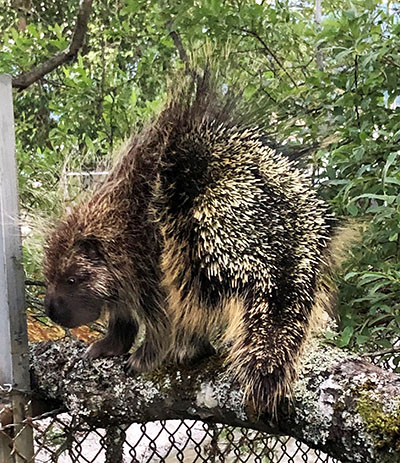
This misconception is surprisingly widespread and, in some ways, it’s understandable. People know some animals can project things. Skunks can deliver a nasty oily spray. Cobras can accurately spit venom a meter or two - aiming for the eyes and face. Porcupines are remarkably quick when threatened. They can spin on a dime, a useful talent when a predator is trying to bite your face. They keep that quill-laden backside and that muscular, formidable tail facing the threat. I’ve seen dogs smacked so fast it looked like the tail hadn’t even made contact.
How does the quill delivery mechanism work?
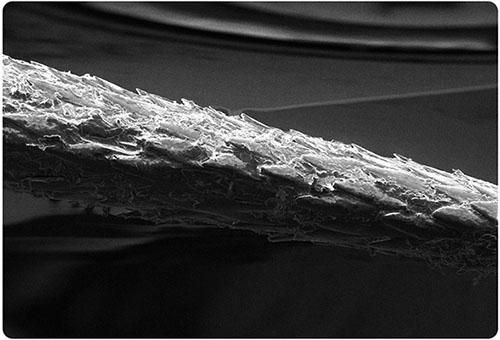
They do make contact. - and amazing things happen in that microsecond “bridging moment” between the porcupine and the attacker. Porcupine quills are microscopically barbed at the pointy end and “adjustably” rooted at the follicle end. Multiple barbs surround the tip - the entire surface of that end of the quill is covered with overlapping scales, and each is an effective barb. When the point pierces the skin, the quill anchors more securely than it is rooted in the porcupine - and it instantly slips right out of the follicle.
Those quills aren’t projected, but they are released. Biologist Uldis Roze, a noted porcupine expert and the author of The North American Porcupine, calls quills “smart weapons.” Roze found that porcupines release their quills more readily when the root has first been pushed back into the porcupine’s skin. The quill base and the follicle surrounding it work together as a release mechanism, reducing the tension about 40 percent to leave that quill embedded in the attacker (see the link at end to Roze’s published paper for exactly how this works).
Sharper than needle-sharp - it cuts its way in
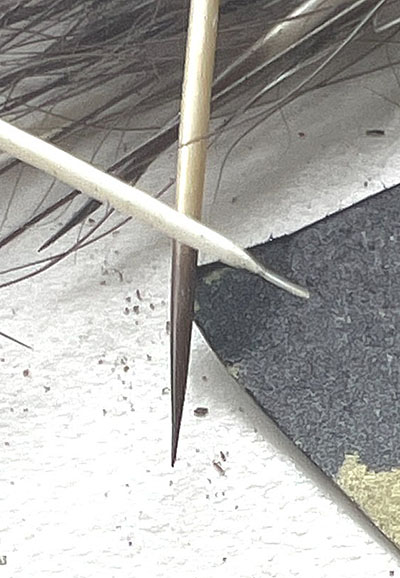
Those scaley barbs do more than lodge the quill, they also facilitate penetration. Jeffrey Karp, a bioengineer at Harvard Medical School, found that to pierce your skin, a porcupine quill needs only about half the force of a hypodermic needle of the same diameter. He not only compared quills to needles, he also tested quills without barbs. He sanded the barbs clean off some quills and tested those with the same result – the scale-like structure of the barbs eases the quill's penetration by concentrating force along the edges of the barbs, not just the tip of the quill. It’s sharper than needle-sharp, not because it’s pointier, but because it cuts its way in like a serrated knife.
Unfortunately, as many dog owners know, getting quilled is just the beginning of the “don’t-mess-with-a-porcupine” experience. The quills are more than embedded - those barbs enable the quill to work its way deeper into the skin. Muscle action flexes the skin and pulls the quill in – and like a ratchet it does not back out. The warmth and moisture of the skin causes the shaft to swell and embed even more firmly. The quills are also coated with a fatty acid that greases penetration. Given a few days the quill can completely bury itself. Uldis Roze tells of getting quilled and having a quill burrow into his arm, travel laterally under the skin, and then come out point-first a few inches further down. I’ve seen this first-hand myself in dogs. Fortunately, that greasy acid compound has antibiotic properties – for more on that read The North American Porcupine.
And a note on pulling quills – There is mistaken advice that a quill will pull out easier if you first clip it in half. Don’t bother, it doesn’t help. They don’t “deflate” or shrink.
More on porcupines
Alaska Fish and Wildlife News article: Porcupine Research – How Tough Critters Survive Alaska Winters
Sounds Wild – Porcupines in winter
Sounds Wild - Porcupine mating season
Video: A coyote tries to bite a porcupine’s face
Porcupines and wildlife viewing
A Facilitated Release Mechanism for Quills of the North American Porcupine (includes more details about quills as smart weapons).
Microstructured barbs on the North American porcupine quill enable easy tissue penetration and difficult removal (and includes medical applications of this)
Subscribe to be notified about new issues
Receive a monthly notice about new issues and articles.